History Channel- The Invention Of The Internet
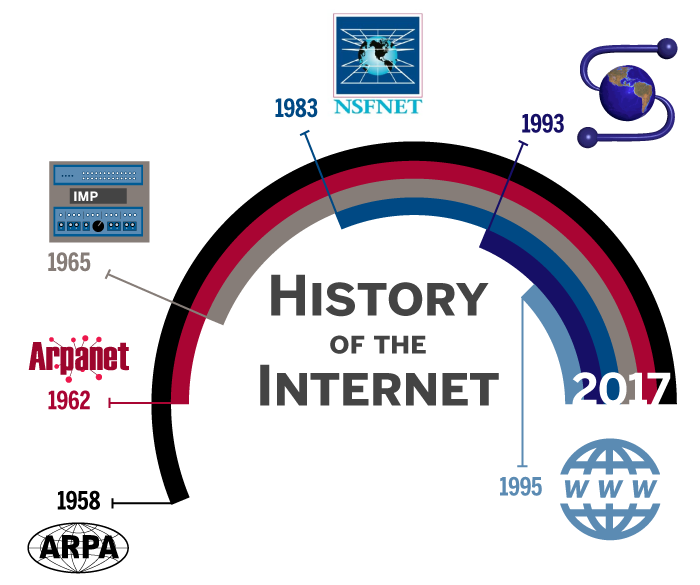



The Internet is no wonder the most defunding technology of our time and historic revolution in communications for the human race that’s changing the world. This big thing is on a par with the wheels and fire and the language and the printing press. Here we find out about how this revolution started and who built this playful toy to millions and how it evolved.
It started in 1950’s, the seminal idea behind the Internet was envisioned by a psychologist named JCR Licklider, a professor at the Massachusetts Institute of technology. His idea was that computers would allow you to communicate better and that would allow you to connect all the computers together so that they might be more useful in the sharing of information among people.
In October 1957, the Bureau at the Defense Department started ARPA i.e. the Advanced Research Projects agency, it was in charge of the space program Sputnik which then included computer science but when the space program got its own agency NASA computer research fell into relative obscurity.
Computer communication was in the embryonic stage, but it was making progress at MIT a graduate student named Leonard Kleinrock began applying Queueing Theory. He displayed how packages of data would queue or line up at the nodes of a communications network as they transmitted through their way.
In early 1960’s , Communication became a security threat because if there is a break in path or telephone system would be so damaged that the military would be unable to launch a counterattack to assure retaliation America needed an indestructible communication. Paul Baran was hired to address the above-mentioned issue. He came up with fish net type network. Later he brought up the concept of hot potato routing.
In 1962 there was enough research and theory to show that a viable computer network could be built but implementing one had to wait seven years until 1969.
An ARPA scientist Bob Taylor, wanted to build a network through which he can intercommunicate, and he was given $1,000,000 to turn his theory to reality. Bob Taylor recruited Larry Roberts, had built the world's first experimental connection between two computers at the MIT Lincoln laboratories in Lexington Massachusetts. According to their Research, if you tried to interconnect the large computers directly then each of those large computers will have to figure out how to work with each of the other large computers so they would have a tremendous problem in their software to be able to figure out the rules and procedures and protocols for dealing with 10 different kinds of computer. In order to overcome this, they came up with the idea of building identical special purpose minicomputers called Imps to form the network and tie them with large computers. Like this they only had to learn how to deal with the one little computer. A small Cambridge Massachusetts company BBN was used to try the ARPANET project. By the end of 1969, they came out in flying colors by completely interconnecting from different sites.
In 1971, a killer application called Email was invented by Ray Tomlinson who also started the ‘@’Symbol.
By 1972, There was almost 25 sites on ARPANET. A fresh graduate from MIT and Harvard called Robert Metcalf was in charge of compiling a list of what all things which people can do on ARPANET.
In 1973, Vint Cerf and Bob Kahn started to develop a new set of rules to interact, they were called TCP/IP protocol.
In 1983, after 10 years of refinement and bureaucratic hassle TCP/IP was declared as standard protocol.
In 1989, physicist named Tim Berners Lee at CERN Research Institute in Switzerland created the World Wide Web.
In June 9th 1992, President Bush passed a bill of taking the Internet out of exclusive hands of Government and giving it to the public.
In 1993, Marc Andreessen developed Netscape, it was a breakthrough application which brought fire to the Internet. The number of users grew by 341000%.
At present there are 11 million domain names and 70 million websites.